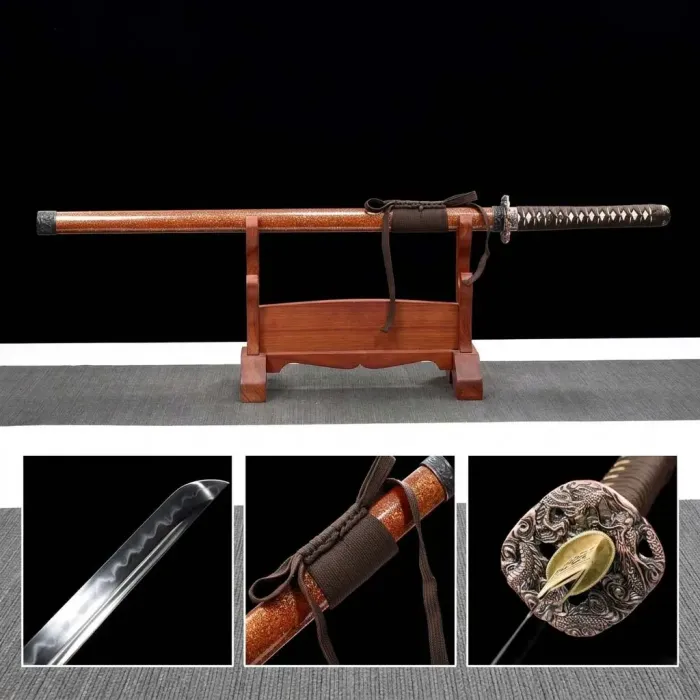
Such age-old ancient blade remains a remarkable piece of craftsmanship, but assume you need to communicate your individual design? Modifying your instrument is a meaningful journey, allowing you to fashion a truly distinctive piece. From the haft wrapping and habaki to the shield design and temper line, each part offers a chance for individual flair. This survey delves into the world of katana enhancements, providing perspectives for both apprentices and accomplished enthusiasts seeking to set their endorsement on the historic art of the samurai.
Starter Verified Handiwork
For learners determined to embark on the exciting journey of eastern weapon training , 1060 steel katanas offer an outstanding entry point. This chosen grade of fundamental steel hits a optimal point between economical cost and performance . While never as hard as upper-echelon steels, 1060 grants a moderate level of sharpening , making it appropriate for learners to develop the rudiments of blade preservation and appreciate the elegance of handcrafted Japanese weaponry. It’s a excellent choice for acquiring experience without the capital burden of more high-grade steels.
T Ten Alloy Sabers : Optimizing Excellence and Reasonableness
Satisfying specialists seeking an authentic katana experience without breaking the bank , T10 steel katanas represent a promising option. These implements offer a considerable improvement in lastingness compared to inferior alternatives, exhibiting sufficient edge retention and tolerable flexibility for elementary cleaving techniques. While not rivaling the outstanding characteristics of top-tier steels like T100 or folded metal , T10 provides a remarkable blend of power and profitability, making them a appreciated choice for initiates and those on a fixed financial .
Past the Metal: Refining Your Armament's Adornments and Grip
As the finished cutting surface is undeniably the primary point of a katana, truly elevating its grandeur lies in the deliberate customization of its hardware and hold. This practice allows enthusiasts to manifest their one-of-a-kind preference . Assess the extensive possibilities: menuki - decorative adornments that introduce visual detail ; the hamon enclosures – often intricately molded ; the tsuka essence itself, wrapped in genuine ito string ; and the fusa terminal , which can be crafted from various ingredients like alloys or shell .
- Pick patterns that harmonize with you.
- Delve into with multiple materials .
- Stress quality for a persistent impression .
The Enchantment of the Katana: Past, Crafting, and Elements
This historical weapon possesses a exclusive allure, steeped in phases of eastern history and folklore . More than merely a weapon of conflict , it's a sign of the warrior ethos – a fusion of dexterity and management . Its evolution spanned multiple generations, with early cutting tools evolving into the graceful curvature and efficient edge we perceive today. The construction involved is truly impressive , requiring epochs of study to excel at . The process involves a multifaceted folding of steel bloom , creating layers that strengthen the edge’s flexibility and shaving ability. Various schools of metalworking started , each with their distinctive secrets and formulas for achieving the ideal equilibrium and edge - a truly strenuous pursuit.
- First Katana classes
- The importance of the katana in samurai culture
- Ancient forging techniques
Picking the Perfect Steel for Your Cutting Tool Project: 1060 vs. T10
Picking the proper steel is fundamentally important for any armament project, and the option between 1060 and T10 can be complicated. 1060 is a prevalent American compound, offering a fair balance of toughness and hardiness, providing it quite easy to temper. However, T10, a originating from Japan steel, usually boasts superior wear lastingness and can perhaps achieve a elevated decisive hardness, although it can be significantly hard to manage and requires careful heat processing. Consider your experience level and aimed features: for a inexperienced, 1060 may be a better entry, while the experienced smith might use the expanded characteristics of T10.
- Effortlessness of Processing
- Edge
- Terminal Firmness
Achieving Mastery: Complex Katana Adjustment Techniques
Advancing competence in blade refinement extends far beyond basic buffing. Serious enthusiasts are now researching advanced techniques to truly unleash a blade's hidden potential. This involves intricate work with the hamon, utilizing specialized compounds for differential annealing and carefully identifying the profile of the hilt guard to optimize balance and efficiency. Beyond purely functional adjustments, artisans are increasingly focused on reaching unparalleled aesthetic beauty, through complex decorating and layered surfaces that truly transform a katana into a exquisite object.
From Raw Steel to Masterpiece: Crafting a 1060 Katana
The journey initiates with common 1060 material , a rigid material far apart the polished katana it will shift into . Experienced bladesmiths carry out a complex process of integrating and forging the unrefined steel, repeatedly glowing it and beating it to rid impurities and produce a homogeneous grain structure. This time-consuming process, often extending for intervals , builds the necessary katana sword power and adaptability characteristic of a genuine Japanese armament . Follow-up heat methods , including meticulous hardening and resting, are vital to achieve the preferred equipoise of sharpness, longevity and attractiveness .- Integrating: Lessens impurities and builds grain structure.
- Crafting: Builds the steel into the initial blade form.
- Cooling: Sets the final hardness and flexibility.
The Durable Charm of the Katana: Intensive Inspection of Steel and Adaptation
A iconic katana continues a strong symbol denoting Japanese culture , its allure far moving past mere arms . Forged from exclusive steel and periodically featuring intricate details , the system of creation itself is a celebrated art. Beyond the fundamental craftsmanship, the ability to customize a katana - from the blade pattern to the handle wrapping and band - permits for a authentically individual manifestation for both devotees and operators alike. This union of legacy steelwork and boundless personalization effectuates the katana's continued prestige across the terra .
